Advice, Education, High School, Technology, Teenagers, Virtual School |
In years past, when a child was enrolled in school, they attended in the traditional brick-and-mortar building. That was the only option. Didn’t matter if the child was gifted and needed a more challenging curriculum, if the child struggled and needed additional time or other ways of learning, or if they had other challenges that prevented them from excelling in that setting. They were essentially stuck and often times, those who struggled ended up dropping out. Those who were advanced were left unchallenged and not learning at their full potential. The good news is that times have changed and there are many ways a child can obtain an education – and that includes learning from the comfort of their own home, at their own pace!
At My Virtual Academy, we take pride in serving those in grades 5 through 12. Our staff is exceptional and we use flexible learning methods to prepare students for their future. We work with many different students such as those who are:
- homeschooled
- struggling in their current school
- looking for an accelerated program
- bullied
- coping with a physical or mental illness
Our online program provides a unique learning experience and is set up to help your student achieve academic success!
Virtual schools are vastly different from their traditional counterparts. Here are some things to ponder as you explore if virtual learning is the right move for your child:
Tuition is FREE
Free is always good, right? Other virtual schools charge tuition but when you enroll with My Virtual Academy, tuition is FREE! This takes a big weight off of the shoulders of our families and allows them to direct their attention to what matters most – their child’s success! We want your child to start off on the right foot and for that reason, in addition to being tuition-free, we provide them with everything they need to be successful…this includes a computer and all required software while in the program.
A Dose of Flexibility
It’s not always realistic to have set, mandated school hours. Appointments come up; kids get sick; life can sometimes get in the way. Instead of falling behind or being reprimanded for missing part of the school day, your child completes the coursework on their time frame. They complete the coursework when it’s best for THEM. Some online courses may ask them to participate in a real-time meeting, but almost everything is done on their own time. Also, it’s important to note that coursework can be completed just about anywhere that has the Internet! If you have downtime in between appointments or are traveling, your student can easily stay caught up on their studies.
Extraordinary Materials and Staff
All of our teachers are certified in the state of Michigan and have worked diligently to prepare thorough, exceptional lesson plans. As we mentioned, we want your student to succeed. We provide a computer and software that is necessary for our virtual school. Our coursework is relevant, current, and competitive and will keep your student on the fast track to success.

Bully-Free Zone
Bullying is all too prevalent these days, especially at school. We work hard to advocate for those who have been bullied in the past and it is not tolerated on any level at our school. Students who have been the victim of bullying in their previous school should feel safe and secure knowing that they are working from the comfort of their own home. That should reduce anxiety related to schooling and help your child direct their focus on getting good grades, which is where it should have been all along.
Paced Learning
Whether your child works at a high rate of speed or needs a bit more time to rehash their studies, we’ve got them covered! Your child may choose to work their way through at a faster rate, therefore completing their education much quicker than if they were in a traditional school. This is a great option, particularly for those who are eager to enter college or the workforce sooner than expected. On the flip-side, if your student needs additional time when it comes to their schoolwork, that’s okay too! They are behind the wheel, so to speak, and there isn’t any pressure from teachers if they need a little more time.
Self-Motivated, Independent Scholars Excel
By its nature, virtual schools tend to be less structured than traditional classrooms. Children who are self-motivated and who prefer to work independently rather than in groups really excel with this learning method. Your student will remain in frequent communication with their teachers and mentors, who will help keep them on track and on the path to graduation. Even with those check-ins, they’ll have enough space where they can work on their own without someone monitoring their every move.
We strongly believe that My Virtual Academy will be the perfect fit for your child. Should you have any additional questions or would like to enroll your child, please reach out to us online or by phone at 800-297-2119.

Activities, Creative Learning, Education, Family Fun |
When fall finally rolls into town, we’re all ready for it! The dog days of summer have come and went and we are ready to start nestling down in our cozy sweaters and fall boots. It’s also a time when people love to be outdoors. The beautiful leaves are changing colors and beginning to fall, the air is crisp and fresh, bonfires are to be had and chili is to be made. It’s the perfect time of year, especially in Michigan!
To get your kids outdoors and active when the weather starts to dip, why not entice them with a fun fall scavenger hunt? There are all types of things they could look for and places to go do them. You could explore a nature center, a metro park, or even simply your own back yard.
Not only will the kids learn about science, but you can also incorporate math and maybe learn a bit about history too, depending on where you decide to hunt. Encourage kids to really take in the beauty and nature around them and look at things with a keen eye.
You may want to pack along binoculars, bug catchers, and magnifying glasses so they can observe what they see. Sometimes all it takes is looking at something in a different way to spark a love of nature in someone! Also, make sure to bring along a pencil for checking off the found items and a little Ziploc bag to bring home found treasures!
Scavenger hunts can be fun for all ages, too. Even the tiniest of kids can forage around looking for easy to spot things. As your children get up in age, make the hunt harder and include things like certain types of leaves, hard to find nuts or berries, and different types of animal tracks. It really is a fun event for all in the family, regardless of age!
We’ll provide links at the bottom to free printable scavenger hunt pages for your younger children, but if you have children that are older in age, don’t fret because there are plenty of ways to get them immersed in the outdoors too.
Middle Schoolers
As the parent of a tween, it can sometimes be a challenge to get them motivated and off the video games or phones and into the outdoors. If there’s something else that we know about tweens, it’s that they love to eat, so pack some of their favorite foods and hit the road. Pack a lunch and make an afternoon of your adventure! Drive a little bit to a new state/metro park where there is lots of room to roam and places to discover!
Next, try to look for new things, like fox tracks or unique birds that are native to that area. Kids this age will get bored if you make the scavenger hunt too simple. Asking them to look for harder to spot items will make your exploration that much more fun. If you have a tween who is resistant to the idea of a scavenger hunt, then take the lead and point out interesting or unique things along your walk. This will get them learning about their environment in a more subtle way.
Have activity trackers? Another way to get your middle schooler interacting with the outdoors is to put those puppies to use and have a good, old-fashioned competition! See who can get in the most steps by taking different paths to the creek or who can get their heart rate pumping when choosing the hilly trail instead of the flat, lower level trail.
Hiking is a sure fire way to build up your appetite so take a minute to meander over to the lake or a favorite spot you found along your path and have a picnic lunch. If you’re by the lake or pond, you could discuss what type of fish you think are in there, how different species affect the balance of the pond, and perhaps you could even discuss the types of boats you see on the water and why people chose to cruise on a kayak or sailboat versus a speed boat. The opportunity to learn and engage your child is everywhere you look when you are outdoors. Nature is your classroom and everything provides a learning experience!
High Schoolers
Getting your teens out for a fall nature hike is a bit easier than it is for those in the tween years. Often times, they are up for the exercise and enjoy a change of scenery. Offering to bring a friend or two along never hurt either!
Instead of having a print out of things they are looking for, keep your teens involved by stopping to point out things along the way that you find interesting or that they could research. For instance, if you find a patch of unique greenery, ask them if they know what it is. If they don’t, you could encourage them to bring out their cell phones, do some detective work, and determine what it is. Same goes for determining what type of trees are in their forest around them. Are the leaves broad or narrow? Soft or needle-like? Is the plant they see poisonous or okay to touch? Can they identify a bird just by their song?
The questions about things they will encounter are vast and by asking them to research and find out the answer, everyone will be learning!

Keep an eye out for the following and try to get your high schooler to identify them:
- Berries
- Trees
- Birds
- Plants
- Rivers and where they flow
- Various types of seeds or pods
- Animal holes or homes
You can learn things in any environment and at any age! The world is a great place to explore and there are many parts that remain unknown. Getting your child engaged and interested in the world around them will help them care for and protect our planet and is a great thing to do.
Have little ones and are looking for free printable scavenger hunt ideas for the fall? Check out these pages for great, easy-to-follow hunts for you child:
We have a passion for learning and would love to help instill that in your child too! If they are in grades 5-12, we would love to discuss how virtual learning could help your child. Please click here for more information. The staff at My Virtual Academy looks forward to hearing from you!

Advice |
 Often times, as adults, we think our children don’t have a care in the world. We think they should have no reason to have stress or worries, but a study done by the American Psychological Association says we should rethink that. In fact, it revealed that 1 in every 5 children worry a great deal and stress like that can take a toll both mentally and physically. Just like everything else, knowledge is power so let’s explore signs to watch for, reasons why children tend to be stressed out, and ways to help them cope.
Carrying the Weight of the World
When a child’s only responsibilities are to focus on school, help around the house, and possibly partake in an extracurricular activity or two, parents often dismiss the notion that their child is under stress. After all, they have no bills to pay, mouths to feed, why should they be stressed, right? Actually, we couldn’t be more wrong!
Kids under the age of 17 have noted that they often feel stressed about keeping good grades in school, financial struggles within their family, and getting into a good college. Frequently, stress comes from peer groups and pressure to fit in at school, parents going through a divorce, switching schools, and other outside sources. This pressure to perform at a high level makes their stress unbearable.
Stress can also come from what they observe in their surroundings. Every day, the news gets worse and worse, it seems. Is the TV on where they are listening and worrying about what is occurring in the world? Do they overhear you talking about marital problems, financial burdens, or possibly an ill loved one? You may think they aren’t listening and taking it all in, but kids are more observant than we think.

How will you know if your child is having a high level of stress? There are some key things that you can look for, such as:
- Headaches
- Short temper
- Sleeplessness
- Feeling sick; upset stomach
- Irritable
- Wanting to withdraw
- Bed wetting
- Trouble Concentrating
- Lying
- Bullying
- Nightmares
- Thumb sucking, in younger children
- Big change in academic performance
- Defying authority
Ways to Minimize and Cope with Stress
If you found yourself able to check off some of the signs above, then most likely your child is like many others and is experiencing some level of stress in their life. Stress that is left to fester and build up can cause many other problems, even in children and young adults. Some youth have had cognitive impairment, depression, increased heart rate, and suffered from exhaustion.
No parent wants their child to suffer from those ailments, especially at such a young age so it’s important to have some tools in your belt that will help you and your child work together to minimize the stress they are experiencing.
First off, make sure to let them know that you are there for them. This doesn’t have to always be a big, forced, and drawn out, serious conversation. Just by being present with them and asking about their day can go a long way. They need to know that you are there and made time for them each day.
If they don’t feel like talking, don’t push. If you happen to know what they are stressed about but they don’t want to talk, just let them know that you’re ready when they are. They’ll eventually come around.
If your child will discuss what is bothering them, listen first, and then do not minimize their worry. Instead, work with your child to brainstorm ways to improve their situation and reduce the stress. We are a society who values being busy but maybe it’s time to cut back. Do they have too many obligations and would they feel better if perhaps they did just baseball instead of baseball, soccer, and tennis? Freeing up some downtime might make a huge difference.
Sometimes it helps talking to a teacher or other adult if they don’t want to open up to a parent. You may be disappointed if they don’t choose you to confide in, but the important thing is that they are hashing out their stressors with a trusted adult and making positive progress.
As we mentioned, the news can be particularly worrisome so if it’s on or being discussed amongst adults, take the information being discussed and tweak it to fit the age of the child. Sometimes just an explanation can set a young ones mind at ease. Older teens may ask lots of details, while younger children don’t need to know all of the nitty gritty.
Often times books can be a subtle way of showing coping mechanisms for stress. Good books can be a fun, less threatening way of showing how others faced stressful situations and made changes to better their situation or reduce their load.
Lastly, if you have exhausted every avenue but your child is still facing extreme stress, it may be best to have them speak with a counselor or psychologist to work through their challenges. Keep in mind, some stress is perfectly natural. Everyone has some degree of stress, from toddlers to adults, but when it starts to affect daily living or your health, it’s time to take action.
Creative Learning, Family Fun, STEM |
There are tons of projects that you can do from home all year round that teach kids STEM, but with any holiday come new, exciting projects that are sure to keep your child entertained while learning a thing or two! Check out these Halloween themed STEM projects that are sure to have your child’s wheels spinning and creative juices flowing.
Magnetic Slime
Slime is all the rage these days and kids always seem eager to learn new ways to make this gooey, slimy, gross concoction. That’s where magnetic slime comes in! It’s super stretchy and squishy and does some pretty cool tricks, thanks to the addition of the magnetic element.

Here’s what you’ll need:
- ¼ cup Elmer’s glue
- ¼ cup Liquid starch
- Disposable bowls
- Craft sticks
- Disposable gloves
- 2 tablespoons Iron Oxide powder
- A really strong magnet
Here’s what you do:
- Put the liquid starch into a disposable bowl. Add the Iron Oxide powder and stir until well blended.
- To the bowl, add the Elmer’s glue and mix really well. It takes a while to incorporate, but just keep stirring.
- Put on your disposable gloves and now mix the slime with your hands. Knead well until it’s thoroughly mixed. If you get any black solution on your hands or arms, wash it off right away as it can stain.
- To rid any excess liquid from the slime, dry it gently with paper towel. Once the excess liquid is removed, you no longer have to worry about your hands turning black. It only happens in the liquid state. Once you’ve completed this step, it’s ready!
Try moving the magnet slowly over the slime and watch it dance and rise to the magnet. It’s really cool and your kids from elementary through middle school will enjoy this activity! (Just watch out for little tikes because magnets pose a choking hazard)
Pumpkin Catapults
Who doesn’t love trying to fling something across the room? Just about every kid I know would love to challenge their family or friends and see who can build the better catapult and toss their pumpkin the farthest. Get the challenge started!

Here’s what you need:
- Various size rubber bands
- Plastic teaspoons
- Masking tape
- Fat popsicle sticks
- Mini candy corn pumpkins
- Mini real pumpkins
Here’s what you do:
You child(ren) can use the various objects listed above to build their own catapult. As a suggestion, look up images of actual catapults on the internet so they can pay close attention to how they are crafted. They will probably notice that catapults have a strong, triangular base, require a wedge, and will need an arm to hold the pumpkin.
Once their catapults are built, have them do trial runs starting with the candy corn pumpkins and then take turns launching the real mini pumpkins. Have them measure the distance that each person achieved and then crown a winner!
Pumpkin Castles
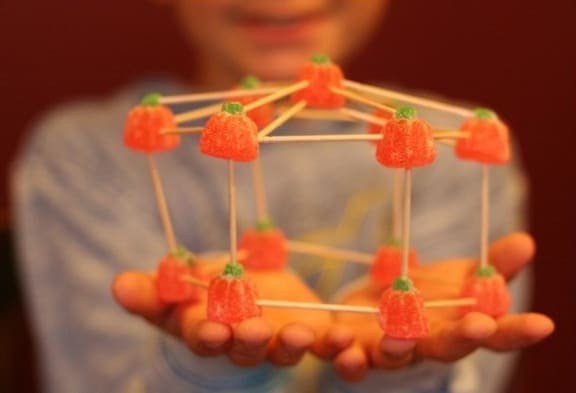
This is a great, fun little activity that even the littlest school-aged kids can do. It only requires to things (three, if you include a little bit of patience!) and is perfect for kindergarten and first graders!
Here’s what you need:
- Toothpicks
- Candy corn and pumpkins
Here’s what you do:
Put the toothpicks in one bowl and the candy in another. Working alongside your child, show them how to construct a castle by using the candy to hold the toothpicks in place. You can show them how to make squares for the base, triangles, pyramids, and cubes. Then, let them have at it and let their imaginations run wild! You’ll be surprised at what they come up with. The best part is at the end, they get to eat part of their creation!
Mutant Eggs
This experiment is so neat and with the added last step, makes it a fabulous, intriguing Halloween project!

Here’s what you need:
- Eggs
- Mason jars or any tall glass
- White or cider vinegar
- Corn syrup
- Green food coloring
Here’s what you do:
- Place the raw eggs into the jars and fill it with vinegar. You can loosely cover the jar if you wish and then leave it on the counter for 24-48 hours.
- Did your child notice any observations when the egg was submerged in the vinegar? Little bubbles formed because the carbon on the egg and the vinegar reacted, causing carbon dioxide bubbles.
- After the time is up, remove the eggs from the vinegar jar and make your observations! The egg no longer looks like a traditional egg. It’s more of a rubbery, balloon-like membrane. Gently rinse off the egg.
- Ask your child what happened to the shell. The shells of an egg are made up of two chemical elements: calcium and carbon. They stick to each other and form calcium carbonate crystals. Vinegar is very acidic and works to break apart the crystals so the shell dissolved and left us with that cool, rubbery membrane.
- In a clean jar, place the rinsed eggs and pour in enough corn syrup to submerge them. Add a few dots of green food coloring. Place the jar carefully in the refrigerator and let it sit for 24 hours. What you are left with are slightly shrunken, green mutant eggs!
- What did your child observe in this step? The egg has shriveled! The membrane let water molecules pass via a process called osmosis. Since corn syrup has almost no water, the water moves out of the egg and into the corn syrup, causing the egg to shrivel up.
We think your kids will have a spooktacular time making these fun and easy Halloween themed STEM projects!
Communication, Education, High School, Technology, Teenagers |
Think back for a minute and envision the days when you were in grammar school. Chances are when I say the word “bullying,” a few faces probably come to mind instantly. You can most likely think of at least one person who was bullied and at least one person who was the one doing the bullying. Every school had them. They existed in every grade. Some bullying was worse than others, but it affected the kids none the less.
The biggest difference about then and now is that back then, we knew our bullies. We could talk to our teachers, our principals, our parents, and try to work out the differences and at least try to agree to put an end to the bullying. These days, the bully is often times hidden behind a computer where the simple strokes of their keyboard leaves imprints on those they bully forever.
Cyberbullying, or the use of electronic communication to bully a person, is faceless and often times nameless. A person can hide behind the keys, so to speak, and be anyone they want to be and say anything they want to say, often times with no repercussion or consequences. It is for this reason that cyberbullying is on the rise and happens so often. Things are said online that one would never have the courage or audacity to say to someone’s face.

Cyberbullying can occur on social media and various apps that the child is using and often times, the parents or guardians are none the wiser. Sometimes parents may find themselves in a situation where they aren’t even aware of all of the apps and websites that their child visits or has accounts on. The greater their online presence, the greater their chance of being bullied becomes.
Knowing the Signs
The good news is that as parents or caregivers, you are not totally helpless in spotting and addressing bullying. There are some signs that your child may exhibit if they are involved with cyberbullying.
Keep an eye out to see if your child:
- Hides their screen or device when you or others are nearby and could sneak a peek
- Won’t discuss what they are doing on the internet
- Has a sudden increase/decrease in frequency of device use or is using it at strange hours
- Shows anger or other high emotional responses when using their device
- Starts to dodge social situations (particularly those that were once loved), becomes depressed, or shows no interest in people and/or activities
- Creates new social media accounts or deletes their account
If you noticed any of these signs, your child may be involved with cyberbullying.
I noticed some signs. What next?
If your child is showing some signs of cyberbullying, it’s important not to push it to the wayside in hopes that it will resolve on its own. Often times, as a means of avoiding confrontation or having an awkward discussion, that’s what happens. Keep in mind that you are the adult. You are your child’s advocate. You know it’s not right and it needs to stop and be addressed.
Let your child know that you are concerned that something is happening to them online and that often times people pick on others in this manner because they are unhappy and lack confidence themselves. Make sure you talk to your child in a private, nonthreatening setting and remain calm and collected.
If they admit to being bullied, dig deeper to try and find out where the bullying is occurring. Often time’s people need to be blocked or accounts need to be deleted and then reestablished under a new user name. This is unfortunate, but can act as a deterrent for the bully.
If the bullying is happening through a school site, administrators should be contacted immediately to help put an end to the situation. All parties involved should be addressed and the manner should be put to rest. If the bullying continues or starts back up, further action is needed by the school.
Perhaps the best way to understand cyberbullying is by perusing the social media, gaming, and other frequented apps yourself. Having an understanding of how they work and how people interact on these sites may prove to be invaluable, especially when you have the discussion with your child and try to take corrective measures. You may have accounts on these sites and have witnessed the bullying that can occur first hand. Knowledge is power and it will help if you know all about those apps that your child visits.

Luckily, devices often are made with a parental control feature. Some are more detailed than others, but they allow you to have some control over what your child is allowed to do while on the computer/phone/tablet/etc. Make good use of these parental controls. Put a lock on various things that could be of danger or should be regulated. This way, you will have to enter a secret code that you created to give them access to those areas. It’s also advised to change that code on a regular basis.
Always remember, you are your child’s biggest role model. They look up to you in every area. Demonstrate positive behavior and positive interactions with others. Assist your child in building self-awareness and teach them to have empathy for others. This goes a long way.
Cyberbullying will probably always have some hold on the internet, because it’s an easy, faceless way for cowards to attack and prey on others. It’s important for everyone to know what to look for to spot if it’s happening, and what to do if they think it’s occurring.
For any additional resources or tips on how to prevent bullying, visit: