
Advice, Creative Learning, Education, High School, Technology, Teenagers, Virtual School |
When it comes to your child’s education, it’s best not to have a “one size fits all” mentality because often times, that’s far from the truth. You may have one child who excels in the traditional school setting while another child is falling behind at a rapid pace. The rate and method of how each child learns can be vastly different. Back in the day, there used to be no real option to help out those who needed a different learning environment, but luckily the virtual schools today can do just that.
At My Virtual Academy, we take great pride in helping students with various learning needs. Our school caters to students who have previously been homeschooled, expelled, bullied, are teen mothers, those who have physical and/or mental illness, and even those who are advanced and need a more challenging, accelerated program. Virtual school has been a saving grace for those students who were struggling day in, day out. Our staff works diligently to ensure that every student has the resources they need to succeed!
Often times, when a student starts falling behind, they think their only option is to drop out of school. They are failing classes and they don’t see any way they could turn their situation around. A virtual school like My Virtual Academy could be the light at the end of the tunnel for students in this situation. With virtual schooling, the student learns at their own pace, in the comfort of their own home. It can reduce their stress, allow them to focus on their studies, and get back on the right path. When students make the switch, they often surprise themselves because not only do they make progress, but they thrive in the new school environment.
On the other hand, students who are gifted might be bored in a traditional brick and mortar school. They may need more challenging curriculum and with virtual learning, they will get just that! It is a great option for students who wish to complete their schooling ahead of schedule or want to stay ahead of the game. The rate at which they learn is up to them.
Virtual learning has benefited students with different learning needs, including:
Struggling Students
The traditional classroom isn’t the best learning environment for everyone. Students with learning disabilities find it hard, if not impossible, to learn at the same rate and in the same manner as the other students in their class. They may find it hard to stay seated for a seven hour school day and their minds may wander or daydream and before they know it, they missed the lesson being taught and are further behind. At My Virtual Academy, our curriculum is tailored to each student’s specific needs, making each course more engaging for the student.
Gifted Students
When a student has mastered their grade-appropriate coursework, it’s time to step up the game and keep them engaged and challenged. By providing stimulating assignments, they are allowed to continue to grow and thrive at the pace that is just right for them. Challenging coursework is exactly what they need to continue to expand their mind and we provide just that at My Virtual Academy!
Those Who Need More Support
Have you ever been in a classroom where a lesson was taught but it simply didn’t make sense to you? Chances are a lot of us have been in that situation. It can be embarrassing to ask for help in front of your peers. Aside from that, sometimes it can be hard to get the one-on-one help you need from the teacher because their attention is divided between 20+ students. That’s not the case with virtual learning! You have access to certified teachers along with a district approved mentor. There is two-way communication to make sure your student is getting the support they need.
Students Experiencing Social Difficulties
Bullying can happen to anyone, anywhere but it is prevalent in traditional schools. When someone is the victim of bullying, it affects every aspect of their life. They may not want to go to school or if they are there, they withdraw. They may start to lash out and begin exhibiting bad behavior. They may begin to hang with the wrong friends as means of aligning themselves with people who may be viewed as intimidating to the bully. Removing your student from that environment and placing them in a virtual school may be just the thing they need to get back on the right path. Their threat of bullying is removed and they can turn their attention to their studies.
Those Who Face Unforeseen Hardships
Life happens and sometimes it gives us more than we feel we can handle. Whether your student and/or family is going through a serious illness, divorce, or unexpected pregnancy, they can still stay on track with school and keep moving forward. When facing a major hardship, it can be very difficult to focus on school work. With virtual learning, you can set your own pace instead of being locked into a classroom during regular school hours.

Our wonderful staff at My Virtual Academy works tirelessly to ensure that every student can succeed. It can be a scary thing to venture out and try a new way of schooling but often times, taking the first step is the hard part. Once you see how much your student loves it and that they are flourishing, it won’t take long to see you made the right choice. We think your student will find that working on their own time, in their own home, in a virtual atmosphere works best.
Give us a call at 800-297-2119 and give your student a fresh start. You can also click here to enroll today!

Activities, Creative Learning, Family Fun, STEM |
Christmas is fast approaching and no matter how old you get, at Christmas time you are always a kid at heart! Keep your middle school kids fascinated by the wonderment of STEM by doing a few of these projects throughout the month. They combine science, technology, engineering, and math to form some pretty cool results!
Simple Science with Snow
Soon the snow should be falling and that will be the perfect time to do this cool science experiment! First up, you’re going to need 3 mason jars. Fill one with ice cubes (not crushed ice), pack one with snow, and fill one about half way with tap water. Next, put the lids on tight and leave the jars on the counter.
 Ask your child what they think the control is in this experiment. The correct answer is the water because eventually, all of the jars will be filled with water. Next, ask why they think the lids are needed. They might say that they prevent evaporation and that is correct! It helps keep all the water inside the jars and prevents it from evaporating into the air.
Ask your children at the beginning of the experiment which jar would end up with the most water. Also ask them which do they think will melt faster, the snow or the ice. These are their hypothesizes. If they are making a quick guess, they might assume that the jar packed with snow might have the most water after it melts. Let them wait and see what happens!
Changes will start happening quickly, so encourage your child to make observations. They could document what they are observing in a science journal. Times should be noted along with their observations so they see how quickly (or slowly) changes are occurring. They’ll start to notice that the snow actually melts a lot faster than the ice cubes; however, very little water is left over once the snow melted.
 The ice could take up to a few hours to melt completely but when it’s done melting, how much water were they left with? The results usually surprise those making the observations. They are left wondering how did the ice cubes, which had a lot of air surrounding them in the jar, melt and give a higher volume of water than the snow? It’s all about the structure of the molecules!
Water molecules take on different structures depending on the state they are in. When water is frozen, it is in its solid state (ice). The molecules are tightly stacked together. If you take a look at the molecules of snow, their molecules fuse together into a crystallized form, giving us the amazing crystal patterns that come to mind when we think of a snowflake.
With this in mind, explain that even though the snow was hard packed into the mason jar, the molecules are still not as tightly fused as they are in the ice cubes. That’s why when the ice and snow melted, the ice yielded more water.
Crafting an Ice Lantern
This is a wonderful, easy outdoor decoration to make that will wow your friends and family every time they come over!
To get started, you will need the following supplies:
- Large plastic Solo cup
- Small plastic Solo cup
- Food coloring
- Tape
- Water
- Room in your freezer (or the outside temp must be below 32 degrees Fahrenheit)
- Candle, battery operated only
- Decorative items (beads, pipe cleaners, pompoms, tinsel, tiny bells, etc.)
To give you a quick synopsis of how this project works, you will add your decorations to the large cup, and then insert the small cup into the larger cup. You will then be adding water to the large cup, allowing it to freeze afterwards. The end result will be your ice lantern.
So, to first get started, have you child think carefully about how they will use their decorations. If you drop your beads, pompoms, and other tiny decorations inside the cup, they will just fall to the bottom. Have them think how they could use all of the decorative items to decorate the entire lantern, not just the bottom. Here’s a hint: they could spiral the pipe cleaners up the side of the cup. The will look like garland in your final lantern and will help to hold the other items in place as they are put in. Let your child know that no matter how carefully they lay out their decorations, they will move some when the water is poured in, and that’s OK.
After the larger cup has been decorated, slip the small cup inside of it. Now you will need to tape the smaller cup in place, so that both cups are level with each other.
It’s time to add the water! Carefully pour water into the larger cup. As you do this, you will notice that the little cup wants to rise. Adding a bit of weight to the small cup will help with that and will keep the cup securely in its place. You can add little stones or rice as easy weights. Fill the larger cup with water until it is about ¾” away from the top of the glass. You can add a few drops of food coloring to the water if you’d like.
 Place the cup in the freezer for several hours until it is frozen solid. Once it’s frozen, have your student look carefully and observe what happened. Even though the smaller cup was weighed down, it has now risen above the larger cup and the water has frozen to the top of the large cup. Explain that this is because the water molecules get tightly packed as the water freezes and it expands in size.
The next step is to carefully remove the cups, starting with the small cup. If the cup doesn’t easily remove, you may need to cut it and remove it in strips. Place your beautiful lantern creation outside for everyone to enjoy! Insert a battery operated candle and it will look beautiful (and since its battery operated, it won’t melt your lantern!).
Do you do any fun experiments with your 5-12th grader during the winter months? Let us know! Head over to our Facebook page and share your experiments with the My Virtual Academy community! If you have any other questions, feel free to call us at 800-297-2119.

Activities, Creative Learning, Family Fun, High School, Teenagers |
Have you thought about introducing your high schooler to the art of poetry? Believe it or not, this doesn’t need to be a drag or something they dread. In fact, by using different methods, teens will love poetry and at this age, poetry can be a great way to express their feelings and creativity. Teens from all over are obsessed with using various forms of printed material to create their poetry. This method is called Blackout Poetry and it’s all the rage.
With blackout poetry, the words that will be used appear in front of the poet in the form of the printed materials, but it’s up to them to breathe new life and significance into the words. The words will take on a whole new meaning as they work to create their poetry.
Blackout poetry is super cool and you only need three things to get started:
- Printed material (an old book/magazine/newspaper)
- Sharpie marker
- Some vivid imagination
The poet will use various words or phrases from the printed material as segments of their poem. Depending on the type of literature they choose to start with, the finished poems would range from silly and off-the-wall, to dark and mysterious. The haphazardness of it all is what makes it fun and unique!
Where to Begin
The student will start with the mindset that creating their poem will revolve around deconstructing their print piece, then reconstructing the words to create their literary masterpiece.

First, the student should read the full page, just as it is. As they read, they should keep an eye out for one word that stands out to them above the rest. This word is very significant and will be considered their “anchor word.” This word should stand out to them because it is powerful, important, and something that speaks to them. Their anchor word should be chosen wisely because it helps guide their imagination and helps shape their work. This word should allow them to spout off different ideas, themes, and topics for their poem. If they are unable to do that, back to the drawing board it is!
With that anchor word in mind, it’s time to reread the page, from top to bottom. As they go, they should circle the words that are related to the anchor word or any words/phrases that speak deeply to them. They will read words that jog an idea or inspire them in other ways – these are the keywords they should circle.
Next, get a separate piece of paper and write down all of the words that were circled in order that they appear in the book or magazine. It’s important to keep them in order and write them as they are written, working top to bottom and left to right. As to not confuse the reader, the completed poem will need to be written in this order.

On another piece of paper, start using some of the words you selected (keeping them in order) to construct the poem. Feel free to remove parts of the word as it might help with the flow of your poem. For example, -ing, -s, -ed endings can easily be removed if it makes the word work better within the poem. As the author of the poem, they may need to try writing several different poems before they find the one that resonates with them and sounds perfect. Often times, they need to revisit the page and see if they missed any words that could be used to help their poem come together. The word needed to complete their poem is usually hiding in plain sight on the page and they just need to take a moment to go back and find it.
Once the poem is perfected, erase the circles around the words that won’t be used in the poem. Next, think of an illustration that would reflect what your poem is about. Draw that over the remaining words that are on the page, being careful not to draw over any circled words. Next, take your black marker and draw lines through all of the words that are not circled or included in your illustration. Doing so will blackout everything except for the illustration they drew and the words used in their poem. The final result is your blackout poetry!
Check out the links below for some great inspiration for your poetry. It’s really amazing how creative and imaginative some students are!
How did it turn out? Did your teen enjoy creating poetry in this cool, unique way? What was their inspiration? We’d love to see what they came up with! Be sure to take a picture of their finished piece and upload it to our
Facebook page so we can share all of the wonderful poetic masterpieces!
Advice, Communication, Education, Virtual School |
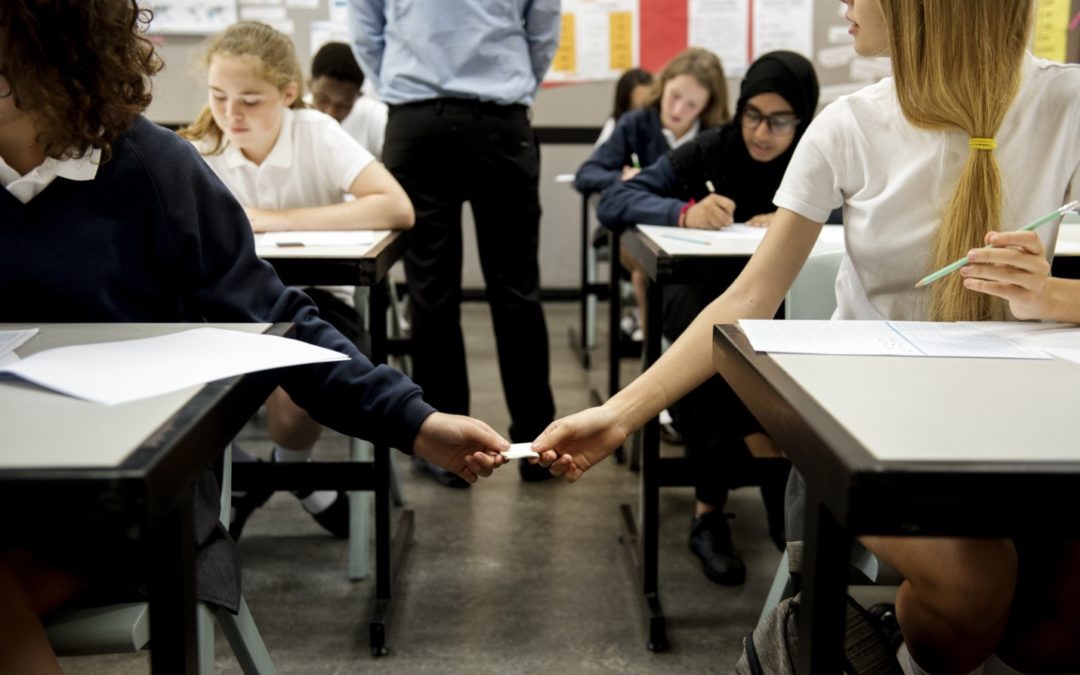
If you think back to the days when you were in school, cheating involved trying to sneak a peek at another classmate’s work or test when the teacher had their back turned. Often times, kids were caught because frankly, they aren’t that good at being sneaky when an adult has a watchful eye on them. Fast forward to school these days – whether we are talking traditional school or virtual learning – and it’s a different world!
Students have access to answers literally at their fingertips. A quick search on the internet will yield answers to almost any question that is on your child’s homework, regardless of the subject. Sometimes that can be beneficial as a means to show parents how to tackle certain math problems for example, but other times it can be an enticing way for a student to cheat and copy the answer from someone else.
If your child is completing their schoolwork online, how do you keep a watchful eye on their internet behavior? How do you make sure that they are doing their own work and not just copying answers from an online forum? There are some helpful pointers to keep your kid on the straight and narrow, so let’s get right into it!
Don’t assume they are cheating.
This is a big one in building trust with your child. Just because someone has the ability to take the easy way out, doesn’t mean that they will. Actually, cheating may seem like the easy way out to parents, but it brings a lot of guilt, frustration, disappointment, and shameful feelings to the student. Often times they are cheating because they don’t understand the material and don’t want a failing grade. Assume the best in your child and their behavior until you have reason to believe otherwise.
Talk to your student.
While you don’t want to assume that they are cheating, you also want to keep your eyes open and not be naïve to the fact that they could be faced with this temptation one day. Having the mindset that your child would never cheat instantly puts up a wall in the line of communication. Sit down sometimes and have a chat with your child. Ask them if they know others who have cheated and if they ever feel tempted to do so. By taking a reasonable approach to the conversation, you are letting your child know it is okay to open up to you should they face this choice.
Open up about your experience.
Were you faced with making the decision to cheat when you were in school? Our children open up to us easier if they feel that we have shared experiences. Share that memory with your child and let them know the decision you made. Did you cheat? Let them know. Then discuss how you felt afterwards, which was probably pretty crummy. Did you opt to give it your all instead of cheating off of a friend? Did you surprise yourself and do better than you thought or did you bomb your test? Open up to your child and you might get a lot back in return by simply sharing experiences.

Observe homework and test taking.
Sure, this step can be time consuming for parents, but sometimes it’s needed. If they were in a brick-and-mortar school, a teacher would be overseeing his/her classroom as they complete their math worksheet or take their social studies test, so the same should be done at home. By overseeing their work, you are ensuring that they aren’t flipping from site to site searching for answers but instead are doing the work on their own.
Ask questions.
Sometimes asking a simple question of how they are doing in their studies will give them the chance to tell you if there is something they are struggling with. If they say they don’t understand a particular lesson, jot a message to the teacher asking for additional help or try to assist them in working through their problem together. This will prevent a snowball effect and will keep your student at the top of their game.
On the other hand, should you notice questionable behavior, ask your student to give you a “refresher course.” If you feel that your student may be cheating on their homework, ask them to act like the teacher and teach you what they are learning. If they can’t explain the material they just learned and are acting fishy, then they may be cheating and you should look into it further.
Discuss your expectations.
Does your child feel pressured to keep all A’s? Help your child ease their mind by discussing what expectations you have of them and their grades. Are you fine with A’s and B’s? Is there a certain grade that they have to get before they can advance to the next lesson plan? Are they cheating as a means of not falling behind? Having an open discussion so that everyone is clear of their expectations can help to reduce school related stress and the need to be perfect and outperform.
Students face a lot of tough decisions on a daily basis and you want to make sure that your student is strong enough to stay away from cheating behavior, even if it means taking a poor grade on an assignment or asking for more time so that they understand the material and can complete the assignment/test on their own.
At My Virtual Academy, we work with students in grades 5-12 who are at various levels of academic ability. We are tuition free and provide everything your student needs to be successful! Our friendly staff and amazing teachers are hoping you’ll come on board and join our school! For more information, please visit our website or give us a call at 800-297-2119.

Activities, Community Service, Family Fun |
It’s that time of year again! The leaves are falling, turkey is to be had, and Thanksgiving is right around the corner. Now is the perfect time to turn your family’s attention away from football and the big feast and figure out ways to “give thanks” and give back to the community. Often times, especially during the hustle and bustle of the holidays, it’s easy to forget about those who are less fortunate than us. Sit down with your family and brainstorm various ways that your family can come together and give back to those in need.
To get the ideas flowing, we’ve jotted down some wonderful ways that your family can start to give thanks. Does your family already have a way that they give back and give thanks each year? Leave us a comment below or on our Facebook page. Let’s hear all the great ways that My Virtual Academy helps the community now and all year!
Fundraise for a charity
We’re all familiar with the Salvation Army bell ringers that are at storefronts during the holidays. They are hard at work in the frigid temperatures to raise money for those in need. Your child could do the same! Now, we don’t mean have your children ring bells or ask strangers for money, but maybe leave flyers on your neighbor’s doors stating that you are doing a bottle and can drive with the money benefiting a charity of your choosing. Or, you could go door-to-door asking for donations from those neighbors that you know. They also could ask bring up their fundraising endeavor to relatives and see if they will contribute.
Another fun, creative way to fundraise is to have your kids make holiday cards that they could sell individually or as a bundle of 5 or 10, with the money going towards the charity. Sometimes people like to feel that they are getting something in return for a donation and this would be a creative way to do so. If you choose to fundraise, please always make sure an adult is present when going around your neighborhood. It helps keep everyone safe and lets the homeowner know it’s a legit fundraiser.
Clothing and/or food drive
How many of us have old clothes lying around or clothes that their teen rapidly grew out of during their umpteenth growth spurt? Yes, us too! Why not hold a clothing drive? Shelters are ALWAYS in need of clothing, toiletries, shoes, food, etc. There are a ton of shelters, so all clothing sizes collected could certainly be used and appreciated. You would be surprised at the amount of clothing that people would donate to your cause when they hear you are collecting it. It saves them a trip to the thrift store and helps them thin down their closet!
In addition to clothes, food is of utmost importance for those in need. Collecting canned goods and other non-perishable items is easy, as most people have some that they don’t mind giving, especially during this holiday season.
Making and delivering meals
Volunteering in soup kitchens is a great thing and those kitchens always appreciate the extra help, but everyone and their brother volunteers there during the holidays. You’ll be tripping over other volunteers while you’re there so why not take your good intentions but redirect them to those surrounding you that might need a warm meal too? If you know of someone who might have handicaps that make it hard to make a meal or is elderly and could use some assistance, why not make a little extra at mealtime and make them up a plate? They would be happy to have the warm meal and the relieved burden that they didn’t have to worry about what to cook that night for dinner. Have a relative or neighbor who might be lonely? Why not invite them over to dinner? A hot meal and friendly conversation goes a long way and could make their day.
Handwritten notes of thanks
‘Tis the season for “giving thanks” so why not put the pen to paper and write a note of thanks? Have each person in your family write down people who made an impact on their lives or who simply did something nice or thoughtful that deserves recognition. The list could include teachers, coaches, mentors, tutors, siblings, parents, bosses, neighbors, etc.
You can either make the cards out of paper at home or purchase blank cards inexpensively at your local arts and craft supply store. Have each person pen a thoughtful letter giving thanks to that person in their life. Then, simply drop them in the mail with postage or hand-deliver them for an extra personal touch. We often think of things we wish we had said to someone once they are gone, so take this as a golden opportunity to let them know how much they mean to you.
November is a wonderful kick-off to the holiday season so start the season off right by lending a hand. Getting your kids involved teaches them from their youth that helping others in your community is an outstanding thing to do. After all, we know what they say, “it takes a village.”
Have you liked our Facebook page yet? Our staff at Back On Track is always sharing important information concerning both you and your student so head over and start following us today!